
BOP Hardy Release Coverage
The Federal Bureau of Prisons holds sentenced federal prisoners. It is relevant to a Hardy County connection only when federal prosecution or a documented transfer led into BOP custody. It is not an alternate regional-jail search and does not cover a West Virginia sentence merely because the arrest happened in Hardy.
BOP's Inmate Locator generally covers federal prisoners released since 1982. A former prisoner may appear with Released or Not in BOP custody and a date. A future date is projected. Unknown means the term has not been determined. These labels describe BOP custody, not every legal restraint.
| BOP display | Meaning |
|---|---|
| Named facility | BOP reports a current designation |
| Released | The person left BOP custody on the shown past date |
| Not in BOP custody | BOP no longer holds the person |
| Future date | A projection, not a completed release |
| Unknown | BOP has not determined the term/date shown |
Search a BOP Release
Open the official BOP Inmate Locator. A federal register number is the best key when known. Name search also accepts identifying data that can help distinguish people. Compare age, race, sex, register number, and facility or status before relying on a match.
- Confirm a federal sentence or BOP commitment exists.
- Search by register number when available.
- Otherwise use the exact name and comparison fields.
- Read whether the date is past or future.
- Check the federal judgment for supervised release.
- Use BOP FOIA for a fuller historical custody record.
The official BOP locator screen shows the proper federal search fields:
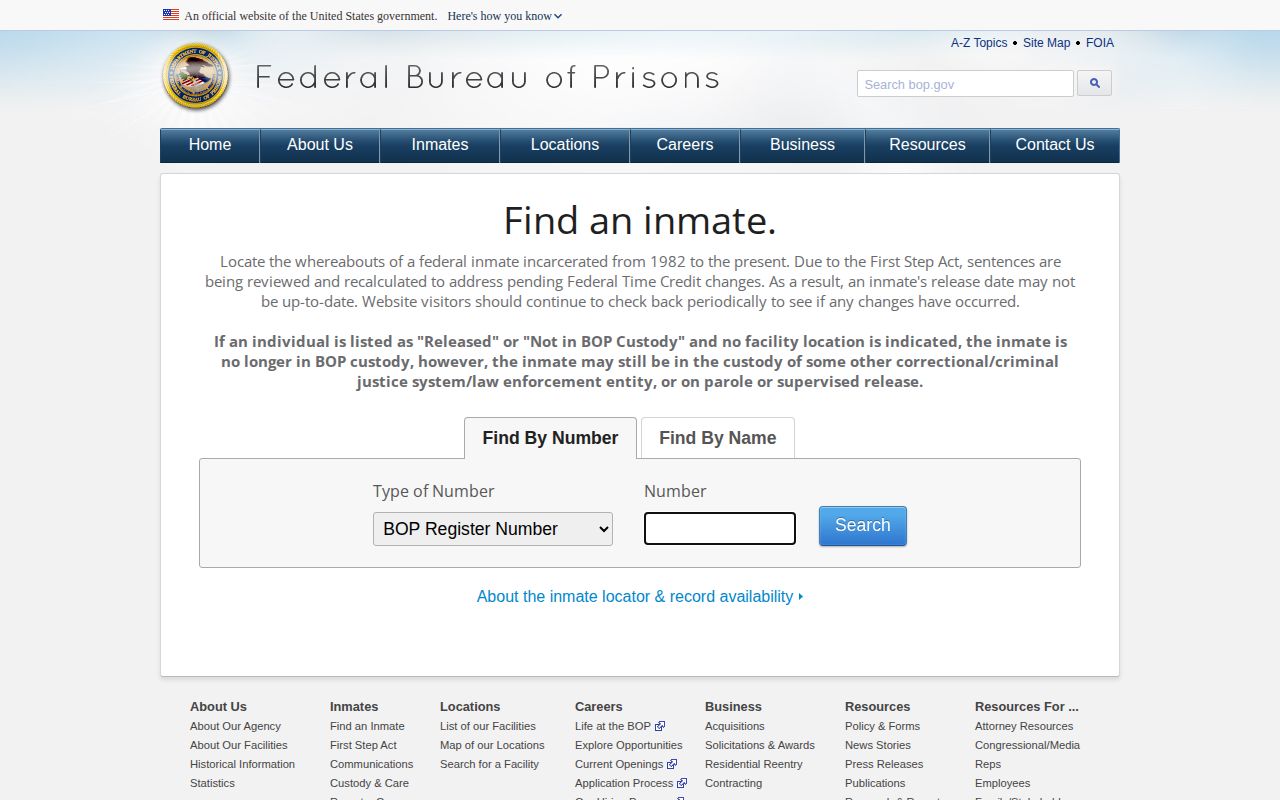
The image documents the tool, not an individual's release. Always compare the federal identifier and judgment.
BOP Records and Contact
Research found no federal prison in Hardy County, so there is no local BOP facility address or phone to publish. Use the verified national agency locator and BOP FOIA channel. A local county office cannot produce a federal prison release record that it did not create.
Federal Bureau of PrisonsNo prison located in Hardy County
Use the official Inmate Locator for status
Use BOP FOIA for historical agency records
A focused FOIA request should identify the former inmate by full name, register number, date of birth, and a narrow time range. Ask for the admission and release record or other specific existing custody document. Do not ask BOP to interpret a state court case or create a narrative.
BOP Release Versus Supervision
Federal supervised release is a term ordered by the federal court and served after prison. It differs from West Virginia parole and Hardy County probation. A BOP Released result confirms departure from BOP physical custody, but the federal judgment can still require supervision through the federal probation system.
Use the federal docket, judgment, clerk, or counsel for the term and conditions that are publicly available. A BOP date does not show whether another sovereign took custody. State warrants, ICE action, or a U.S. Marshals matter can follow the BOP event.
- BOP release
- Departure from Bureau of Prisons custody.
- Supervised release
- Federal court supervision after imprisonment.
- Detainer
- Another authority's request to receive or hold the person.
- Transfer
- Movement to another custodian, not release to the community.
Hardy State Versus Federal
For an ordinary Hardy arrest held before trial, start with Potomac Highlands Regional Jail and WVDCR's regional search. For a West Virginia prison sentence, use WVDCR's prison search. Use BOP only for a federal sentence. The court caption, docket, register number, and commitment papers establish the system.
A person can have both state and federal matters. In that case, one agency's release may simply start the next agency's custody. Read the movement destination. If PHRJCF releases a person to the U.S. Marshals Service, the event is a transfer even if the regional roster stops showing the name.
Request a BOP Release Record
The public locator can be enough to establish that BOP reports a past release date. For more detail, request an existing record. Include the full name, register number, birth date, facility if known, and dates. State that the requested subject is the admission and release history or another named record.
Federal exemptions and privacy rules can limit disclosure. Ask for reasonably segregable nonexempt portions if part is withheld. The federal judgment can establish the sentence and supervised-release term, while BOP's record establishes its custody dates. Neither should be substituted for the other.
BOP Custody Timeline
A useful timeline places the judgment date, BOP admission or designation, projected date, actual release date, and start of supervised release in order. If a detainer appears, add the receiving-agency event. One date cannot explain every transition. BOP maintains the prison phase, while the federal court maintains the order imposing the sentence and later supervision.
When the locator says Not in BOP custody without a full explanation, do not fill the gap with guesswork. Search the federal docket for a release order or judgment, ask the clerk about public filings, and request the specific BOP record. If a documented transfer names ICE or a state custodian, verify that next event with the named agency.
BOP Date Limits
The locator's broad starting point is 1982 for released federal inmates. Older records may require National Archives or agency research. Name changes, spelling, missing identifiers, and historical record scope can prevent a match. A negative result does not prove the person was never in some federal custody.
U.S. Marshals pretrial detention is also distinct from BOP imprisonment. USMS has no comparable public locator. A person may spend federal pretrial time in a contract or local facility before BOP designation. Use the federal docket and USMS record route for that phase.
After a BOP Release
Check the federal judgment for supervised release. If an immigration transfer is documented, use ICE's locator or field-office channel. If a state detainer is documented, use the receiving state's official system. Do not infer any of those outcomes from the BOP label alone.
Release planning and actual release are also distinct. A future date in the locator is subject to agency calculation and later events. A past date beside Released is much stronger evidence of the completed BOP event. Even then, the receiving-custody question remains open until another record closes it.
A federal court order can show whether the person was released on conditions before sentencing, committed to BOP, or sentenced to supervised release after prison. It may also identify a revocation. Use the document filed in the case, not a short news account or an unsupported estimate. For an exact custody start or end, pair the judgment with the BOP admission and release history.
When two people share a name, a register number prevents a serious mismatch. Keep the number with the copied result and note the date the locator was checked. Public status can change, and a saved result should not be presented as live months later.
The Hardy County released inmate search helps route a person among regional, state, federal, and immigration systems. Note: BOP status proves only what the federal prison agency reports about its own custody.
BOP Identity and Date Check
A federal register number should stay attached to every saved locator result. Names can repeat, and the locator's demographic fields are comparison aids rather than independent proof. Record the day the search was run because a future projected date can change and an institutional designation can later become a released status.
For a past release, compare the displayed BOP date with the federal judgment and any later docket entry. The judgment establishes the sentence and supervised-release term. The BOP record establishes its prison custody. If dates differ, request the agency record rather than choosing the most convenient one.
A person released from BOP may report to federal probation, transfer to ICE, or enter another sovereign's custody. Those events require their own sources. The phrase Not in BOP custody should never be expanded to “free from all custody” without that follow-up.
BOP Release Status Terms
Keep BOP terminology intact. Released with a past date shows the agency reports a completed BOP exit. A future date is projected. Unknown means the term has not been determined. Not in BOP custody says only that BOP does not currently hold the person. It cannot prove that federal supervised release ended, that ICE has no case, or that another state lacks custody.
For a Hardy connection, note the federal case number as well as the county link. Place of arrest alone cannot identify the custodial system.